
The Reserve Bank of India (RBI) on Friday kept the key repo rate unchanged at 4 per cent in view of rising inflation and faint signs of economic growth amid the gradual lifting of coronavirus related countrywide lockdown.

Given the various risks to growth, one could argue for rate cuts to be deeper than the 5 per cent terminal repo rate that we are projecting at this stage, says Kaushik Das.

In the backdrop of the crisis brewing at Paytm Payments Bank, major fintech companies are ramping up their workforce and inducting new faces in their leadership teams, industry sources said on Wednesday. Users will not be able to add funds to their Paytm Payments Bank Wallet after February 29, though they will still be able to use the services and the existing balance in the wallets, according to the Reserve Bank of India (RBI) diktat. Industry sources said that competitors to Paytm are investing heavily in offline payments while doubling their salesforce.

The central bank held 72.5 per cent equity in Nabard worth Rs 1,450 crore, of which 71.5 per cent amounting to Rs 1,430 crore were divested way back in October 2010 and the residual shareholding was divested on February 26, 2019.
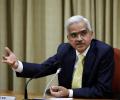
The Reserve Bank of India (RBI) on Friday decided to leave the benchmark interest rate unchanged at 4 per cent but maintained an accommodative stance, implying rate cuts in the future if need arises to support the economy hit by the Covid-19 pandemic.

The economy is gaining traction with gradual pick up in manufacturing activity and moderation in contraction of services, spurred by comfortable liquidity conditions, an RBI article on Tuesday said. Observing that the retreat of the second wave of coronavirus pandemic has been slow, the RBI in an article on the 'State of Economy' said, the aggregate demand conditions are buoyed by the release of pent-up demand post unlock, while the supply situation is improving with the monsoon catching up to its normal levels and sowing activity gaining pace. "Reaffirming the traction that the economy is gaining, the manufacturing activity is gradually turning around, while contraction in services has moderated.

The eight-member committee under Sinha will also examine the factors affecting the timely and adequate availability of finance to the sector.

The services sector growth in India rose to a 13-year high in September on sharp increase in new business amid strong demand conditions, and job numbers continued to increase as overall business mood improved, a monthly survey said on Thursday. The seasonally adjusted S&P Global India Services PMI Business Activity Index rose from 60.1 in August to 61 in September, signalling a sharp upturn in output. In Purchasing Managers' Index (PMI) parlance, a print above 50 means expansion while a score below 50 denotes contraction.

The finance ministry expects a broad-based moderation in inflationary pressures on the back of an anticipated reduction in food prices as a result of the uptick in summer sowing. The retail inflation rate remained stubbornly clung to the 5 per cent mark in seven of the past eight months. "Core inflation is trending downwards, indicating a broad-based moderation in price pressures... Driven by strong domestic growth and benign global commodity prices, core inflation is declining continuously.

The government on Friday gave wide-ranging legislative powers to the Reserve Bank of India to issue directions to lenders to initiate insolvency proceedings for the recovery of bad loans.
Given the pressure from India Inc and the banking fraternity, it is surmised that the portfolio rejig will take place before April.
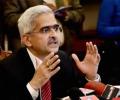
All members of the Monetary Policy Committee (MPC) -- Shashanka Bhide, Ashima Goyal, Jayanth R Varma, Mridul K Saggar, Michael Debabrata Patra and Shaktikanta Das -- had unanimously voted to keep the policy repo rate unchanged at 4 per cent after the three-day meet of the panel earlier this month. Further, except Varma, other members voted to continue with the accommodative stance as long as necessary to revive and sustain growth on a durable basis and continue to mitigate the impact of COVID-19 on the economy, while ensuring that inflation remains within the target going forward. Varma expressed reservations on this part of the MPC resolution, according to the minutes.
However, the RBI is still not in a mood to issue an OMO calendar, which was the expectation in some sections of the market.
The bank's board has already established a search and selection committee comprising three members from the existing nomination and remuneration committee along with two external experts to identify Kapoor's successor.

Urjit Patel panel wanted all members to be appointed by RBI

'India is not so distant from years of high and entrenched inflationary expectations that it should start trying to play games with the economy the way the West's central bankers think they are entitled to,' argues Mihir S Sharma.

This comes against the backdrop of instances of indicative ratings given by agencies, for which there are no written agreements.

Heading to the third year, will Urjit Patel be busy firefighting a currency crisis? Almost no governor of the RBI managed to evade it and Patel perhaps knows it.

The Reserve Bank of India (RBI) has clarified that loans which have remained standard without any defaults as of March 1, 2020, will be eligible for restructuring under the pandemic-related resolution framework issued in August.

'The critics are getting carried away.' 'The challenge for the RBI is not any erosion of autonomy caused by demonetisation.' 'It's the whole attempt to reduce the RBI's stature and role that has been under way,' says T T Ram Mohan.
'We have a plan to plough back a 'This year in the first half we had profits of more than Rs 31,000 crore.' significant amount of profits this financial year.' 'We have seen this organic plough back of profit is one of best ways to support the equity of the bank.'

If imputed inflation for April and May is used, then you have inflation of over 6 per cent for two consecutive quarters, which is a worrying signal for the RBI.

A high power committee comprising heads of various probe agencies and specialised departments has been constituted to monitor the investigation and steps taken to bring back black money stashed in foreign banks, Government told the Supreme Court on Monday.

A Kotak research report expects RBI to cuts rates by 50 basis points in the first half of 2019. RBI will announce its sixth bi-monthly monetary policy on February 7.

As per the RBI Act, the central bank should have four deputy governors - two from within the ranks and one commercial banker and the fourth one an economist to head the monetary policy department.

Most banks led by the State Bank, have or are going to declare DHFL account as NPA in the third quarter.
All-out efforts are needed to mitigate the adverse impact of the Covid-19 pandemic, and the RBI will use any instrument necessary to revive growth and preserve financial stability, according to the minutes of the central bank's policy meeting.

One incident should not be used to generalise the health of all cooperative banks, says RBI governor Shaktikanta Das.

Among the Sensex firms, Bajaj Finance emerged as the biggest gainer by climbing 2.95 per cent. Tata Motors, Bajaj Finserv, IndusInd Bank, Sun Pharma, Mahindra & Mahindra, State Bank of India, Larsen & Toubro, HDFC, HDFC Bank, Maruti, Reliance Industries and Bharti Airtel were the other major winners. HCL Technologies, Axis Bank, ICICI Bank, Tech Mahindra and Titan were among the laggards.

'Government of India has the right to give directions to RBI'.
'The assumed linear correlation between forced lower yields, higher bank borrowing from the RBI, higher lending, and higher growth involves leaps of faith, each a step on the quicksand of false beliefs,' warns Debashis Basu.
A staunch defender of demonetisation, it would be interesting to see how he handles the government's increasing demand for more cash from the RBI, and letting some weak banks get out of prompt corrective action.
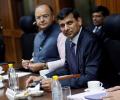
Balance is needed in selecting members for the proposed monetary policy committee, says Abheek Barua.

The Reserve Bank of India, for the second straight time, on Thursday kept its key policy rate unchanged at 5.15 per cent, maintaining its accommodative policy stance as long as it was necessary to revive growth. The central bank retained GDP growth at 5 per cent for 2019-20 and pegged it at 6 per cent for the next fiscal.

Pressure has been mounting on the Reserve Bank of India to cut interest rates in the wake of declining retail inflation and the need to fuel growth momentum. However, the RBI will have to do a tightrope walk as globally interest rates are inching upwards.

The final and most significant reset in the relations between the government and the RBI is the manner in which the process of appointing the governor and deputy governors of the central bank has been changed.
Many analysts over the past week have said the RBI has legroom to cut rates to the tune of 65 bps by June and some like Barclays and BofA have also spoken about the likelihood of an inter-meeting cut.

Despite admitting to price pressures both from food items and input prices, RBI Governor Shaktikanta Das on Wednesday hoped that a normal Southwest monsoon will have a "soothing impact" on inflation pressures and ruled out any wide variations in medium-term inflation forecast from what was given in April. In an unscheduled address earlier in the day amidst the raging pandemic, Das said the overall outlook for the economy is highly uncertain and is clouded with downside risks. He offered a slew of relief and liquidity measures to individuals and small businesses apart from a Rs 50,000 crore special liquidity window to the healthcare sector.
The size of the Reserve Bank's balance sheet, which is reflective of activities carried out by it in pursuance of currency issue function as well as monetary policy and reserve management, has increased by 6.99 per cent during the nine-month period ended March 31, 2021. While income for the year decreased by 10.96 per cent, the expenditure decreased by 63.10 per cent, as per the RBI's Annual Report for 2020-21. The year ended with an overall surplus of Rs 99,122 crore as against Rs 57,127.53 crore in the previous year, representing an increase of 73.51 per cent, it added.
'The PCA framework was revised and tightened in April 2017, but there was no discussion in any board meeting. The government does not know the rationale behind revising the framework and how the RBI arrived at it. Similarly, there was no discussion in the board meeting on the revised NPA framework,' said an official.
 © 2026 Rediff.com - Advertise with us - Disclaimer - Privacy Policy - Sitemap - Feedback - About us - Terms of use - Grievances